
California Native American Tribal Relations
California Native American tribes have lived and stewarded the lands, airs, and waters of what is known today as California since time immemorial and have a unique connection to and knowledge of the environment and the natural, cultural, and historical resources that the California Natural Resources Agency (CNRA) and its departments protect, manage, and restore. As such, CNRA and its departments are responsible for consulting with California Native American tribes.
The State Coastal Conservancy (SCC) is committed to early, often, and meaningful consultations with California Native American tribes with the goal of collaborative partnership and meaningful inclusion of tribal governments’ priorities and interests throughout the Agency’s work. SCC seeks to advance programs, policies, regulations, and laws to strengthen working relations with California Native American tribes and to coordinate tribal affairs policies and programs.
As an agency within CNRA, SCC adheres to the CNRA Tribal Consultation Policy. We have also adopted an addendum to the CNRA policy that explains how SCC’s mission and structure affects its implementation of the policy.
In 2023, the San Francisco Estuary Wetlands Regional Monitoring Program lead the development of Best Practices for Tribal Engagement. The document aims to give helpful guidance to meaningfully engage with Tribes.
Grant Program
SCC holds periodic grant rounds related to specific topics, but many of the Conservancy’s grant programs have open solicitations. Tribes are welcome to apply at any time and may also do so by reaching out to us and/or filling out our general pre-application. Examples of grant rounds include Explore the Coast, Explore the Coast Overnight, Coastal Stories, Wildfire Resilience, Coastal Wetlands, Water Quality, and Sea Otter Recovery.
Project Examples
Ancestral Land Return
Hupa Mountain Land Acquisition
Hoopa Valley Tribe reclaims more than 10,300 acres of their ancestral territory. Hupa Mountain now extends along the western border of the Hoopa Valley Indian Reservation, totaling to 240,000 acres. The Hoopa Valley Tribe plans to enhance and restore habitat for species of concern on the property, including listed salmonids, northern spotted owl, Pacific fisher and Roosevelt Elk. The total purchase price was $14.1 million, with $4.5 million of Conservancy Support.
The Conservancy issued a grant of up to $2,000,000 to the Esselen Tribe of Monterey County to acquire 1,720 acres of the historic Rana Creek Ranch along Tularcitos Creek in upper Carmel Valley to to protect and restore natural resources and wildlife habitat; preserve open space; enable compatible agriculture including cattle grazing; protect cultural resources; provide compatible Native American tribal access and guided public access; and potentially create a tribal education center and tribal housing for property management, as well as returning land to Esselen Tribe.
Habitat Restoration with Tribal Inclusion
‘O Rew Redwoods Gateway and Restoration Project
In 2025, the Prairie Creek Floodplain Restoration Project site at ‘O Rew was completed in partnership with the Yurok Tribe, Save the Redwoods League, CalTrout, as well as many others. The Yurok Tribe Construction Corporation built a new meandering stream channel with abundant features to support fish, two connected ponds and approximately 20 acres of floodplain habitat. Additionally, this project implemented a stewardship program funding the Yurok Tribe Fisheries Department Revegetation Crew to care for the site over the next three years. In 2026, the land will officially return to the Tribe, its original stewards.
Southern Los Cerritos Wetlands Restoration Project
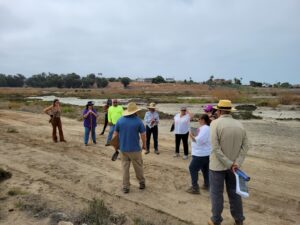
The Conservancy provided grant funding to the Los Cerritos Wetlands Authority for the Southern Los Cerritos Wetlands Restoration Project. Since 2021, grant funding has supported tribal engagement through a Tribal Advisory Group of Gabrielino/Tongva and Acjachemen tribal representatives. The Tribal Advisory Group were consulted regularly throughout the project’s design and provided valuable input on habitat restoration, cultural resources investigations/protection, and tribal access. As a result, sensitive cultural resource areas were protected, and special tribal use areas were integrated into the project. The Tribal Advisory Group continues to be engaged through implementation of the project and through Native American monitoring. In the future, tribes will have unique access to the restored site through a Memorandum of Understanding for tribal access.
Explore the Coast Grant Program
Amah Mutsun Land Trust Summer Camp
The Conservancy provided a grant to Amah Mutsun Land Trust for their summer camp for Native American youth that offers a meaningful and fun experience for Tribal youth to enjoy their coastal ancestral territory and learn about coastal conservation and traditional ecological knowledge. Attendees participated in recreational activities along with cultural activities like jewelry making, learning coastal ethnobotany, and sharing tribal stories about the coast.
Coastal Stories
Through our Coastal Stories grant program, the Conservancy funded a project to tell unique Tolowa stories at kiosks located along the California Coastal Trail and throughout Beachfront Park in Crescent City. The goal of telling these stories in this space is not only to correct one-sided histories by guiding residents and visitors to a deeper understanding and acknowledgement of Taa-‘at-dvn (Crescent City) and its original people, but also to promote a sense of belonging for the Tolowa people on their ancestral land. The process of creating these stories was documented by PBS SoCal in their Coastal Stories series.
Wildfire Resilience Program

Tamien Nation Cultural Fire Stewardship Program
This project led by the Tamien Nation was funded by the Conservancy in June 2023, and will start and train a 6-person native fire crew and support its first two prescribed fire projects at Henry Coe State Park on the tribe’s ancestral homelands, in partnership with California State Parks. The project team collaborates with State Park personnel, CalFire, and cooperating fire agencies in fire training, vegetation management, shaded fuel breaks and prescribed fire projects. The program is a multi-partner cooperative capacity-building and implementation project to restore cultural burning and wildfire resilience on ancestral lands while improving fire protection, enhancing ecological function and tribal cultural resources, and promoting community education.
Contacts
Tribal Liaison and Environmental Justice Analyst
Thomas Morales – thomas.morales (at) scc.ca.gov or (510) 286-0317
Regional Liaisons
- North Coast: Amanda Townsel, Amanda.Townsel (at) scc.ca.gov
- San Francisco Bay Area: Sara Haugen, Sara.Haugen(at) scc.ca.gov
- Central Coast: Hilary Hill, Hilary.Hill (at)scc.ca.gov
- South Coast: Sally Gee, Sally.Gee (at) scc.ca.gov