50 Year History of the Coastal Conservancy
Timeline: California State Coastal Conservancy, 1976 – Present
1976: Coastal Conservancy Act Passes
- Established by the California State Legislature through the Coastal Conservancy Act (Public Resources Code, Division 21), the Conservancy was created as a non-regulatory state agency within the Natural Resources Agency. A core tenet from the start was to ensure public access to the coast, recognizing the public’s right to enjoy California’s shoreline. The Conservancy was designed to acquire land and develop facilities for public use. The Conservancy was established in the same year the Coastal Act, which established the Coastal Commission, was passed. Both agencies were born from a citizen-led movement to protect the California coast and public access to it.
Late 1970s – Early 1980s: Laying the Groundwork
- Early efforts included acquiring critical coastal lands for public access and open space, and initiating small-scale habitat restoration projects. This work involved acquiring key parcels of land to create new public beaches, coastal parks, and trail easements that were previously blocked by private development. The Conservancy began developing strategies for urban waterfront revitalization, recognizing the need to reconnect cities with their coastlines and the framework for a statewide coastal trail system.
1980s: Expanding Access, Influence & Major Acquisitions
- The Conservancy played a key role in numerous significant land acquisitions, securing thousands of acres of sensitive habitat and public access opportunities, often preventing large-scale development. We initiated work on major wetland restoration, recognizing the importance of these ecosystems. During this time, the Conservancy also focused on funding and facilitating public access projects, often working with local governments and non-profits to develop stairways, boardwalks, parking areas, and visitor amenities at numerous beach access points along the California coast, opening up previously inaccessible areas.
Early 1990s: Focus on Large-Scale Restoration & Trails
- Our focus increased on larger, more complex restoration projects as we adopted a watershed-based approach, recognizing that coastal health depends on the health of upstream systems. The concept of a continuous California Coastal Trail (CCT) gained significant momentum with the Conservancy as a lead agency. We began funding strategic land acquisitions and projects specifically for CCT segments.
Mid-1990s: Focusing on Urban Waterfronts & Community Connection
- The Conservancy increased efforts in urban waterfront revitalization, transforming former industrial or derelict areas into public promenades, parks, and trails. This brought coastal access directly to city residents, often those in underserved communities.
- In 1997, SB104 established the San Francisco Bay Conservancy Program within the Coastal Conservancy, authorizing the Conservancy to work in the 9 county Bay Area on projects that protect, restore, and improve access to natural resources. The Conservancy became a leading partner in the Hamilton Wetland Restoration Project in Marin County, transforming a former U.S. Army Airfield into tidal wetlands and managed ponds – a critical project for Bay ecosystem health and flood control.
Early 2000s: Prioritizing Climate Change, Equitable Public Access & Major CCT Progress
- Anticipating the impacts of sea-level rise and increased coastal erosion, climate change adaptation strategies were formally incorporated into our project planning and funding. The Conservancy also began explicitly prioritizing equitable access to the coast, recognizing that not all communities have had equal opportunity to enjoy coastal resources. Projects increasingly focused on underserved communities, developing access close to transit, and ensuring accessibility for people of all abilities. The CCT became a central programmatic focus, with significant funding allocated to close gaps, build new segments, and improve existing ones.
2002: South Bay Salt Pond Restoration Project Begins
- The Conservancy became a key partner in initiating the South Bay Salt Pond Restoration Project, the largest tidal wetland restoration on the West Coast. This ambitious project aims to restore 15,100 acres of former industrial salt ponds in the South San Francisco Bay into a mix of tidal marsh and managed ponds, with profound benefits for habitat, flood protection, and recreation.
2010s: Innovations in Climate Resilience
- In 2012, SB1066 added language to the Conservancy’s enabling legislation to authorize us to address the impacts and potential impacts of climate change on the coast. The Conservancy became a leader in piloting and funding nature-based solutions for coastal protection and habitat enhancement. We also spearheaded efforts to beneficially reuse dredge material to create or enhance wetlands and other habitats. We began integrating climate change considerations into project planning, aiming to fund projects that will be resilient to sea-level rise and other climate stressors.
Mid-2010s – Present: Deepening Equity Commitments & A Broadening Scope
- We further intensified our commitment to equitable and inclusive access, actively seeking out and supporting projects in systemically exclude communities. This includes the creation of our Explore the Coast program, which funds coastal experiences for communities that face barriers to access. Through the development of our Justice, Equity, Diversity & Inclusion (JEDI) guidelines, we identified ways to prioritize equity across our work and in the administration of our agency. New Conservancy programs that are helping to advance equitable outcomes include Explore the Coast Overnight that aims to increase the supply of lower cost overnight accommodation at the coast, and Coastal Stories, which funds storytelling installations that represent communities and voices that have been historically excluded in the narratives of California’s coast and publicly accessible lands.
- The Conservancy’s scope expanded to encompass wildfire. The new Wildfire Resilience program supports local partners to develop and implement projects that improve forest health and reduce the risk of catastrophic fire along the coast, coastal watersheds, and the San Francisco Bay.
- The Conservancy was also tasked with helping to establish and support the newly formed Great Redwood Trail Agency, which is responsible for delivering the Great Redwood Trail, a 307-mile, world-class, multi-use rail-to-trail project connecting California’s San Francisco and Humboldt Bays.
The Future
Looking forward, the Coastal Conservancy will play a vital role in sustaining and enhancing a resilient, accessible, and biodiverse California coast and San Francisco Bay for all generations. Our vision is of a beautiful, restored, and accessible coast for current and future Californians. We act with others to protect and restore, and increase public access to, California’s coast, ocean, coastal watersheds and the San Francisco Bay Area.
News Release: Coastal Conservancy awards over $54 million for Coastal Resilience, Restoration, and Public Access
Today, the Board of the State Coastal Conservancy authorized a total of over $54 million in funding for 28 projects that will help to restore the California coast, expand public access, and improve climate resilience.
Nearly $21 million of the total awarded comes from the 2024 Climate Bond (the Safe Drinking Water, Wildfire Prevention, Drought Preparedness, and Clean Air Bond Act of 2024 codified as Public Resources Code section 90000, et seq)
The grants awarded were:
- Consideration and authorization to disburse up to $1,075,014 of grant funds from the California Department of Conservation’s Regional Forest and Fire Capacity Program to augment the total grant amount authorized on November 20, 2025 for grants to five public agencies to improve forest health and wildfire resiliency, facilitate greenhouse gas emissions reductions, and increase carbon sequestration in forests in Alameda, Santa Clara, San Luis Obispo, and Santa Barbara Counties. These additional funds will be granted to the Santa Barbara County Fire Safe Council and the Native Coast Action Network to carry out planning, wildfire steward training, and workforce development projects in Santa Barbara and Ventura Counties.
- A grant of up to $941,000 to Ducks Unlimited, Inc. to augment a previously authorized Conservancy grant for the restoration of tidal marsh and creation of public access at the Mountain View Ponds (Ponds A1 and A2W) and to disburse $559,000 to the California Wildlife Foundation to conduct monitoring and adaptive management, both of which are part of Phase 2 of the South Bay Salt Pond Restoration Project in Santa Clara, San Mateo, and Alameda Counties.
- A grant of up to $121,000 to Sonoma Land Trust to augment the grant of $1,241,000 authorized by the Conservancy on February 15, 2024 and subsequently augmented by $170,500 to plan for ecological restoration of 280 acres of baylands and alluvial fan in the Tolay Creek Baylands in Sonoma County by conducting community engagement, preparing preliminary designs and environmental compliance documents, and developing a permitting strategy. This augmentation is needed to allow for payment of indirect costs
- A grant of up to $1,448,400 to the Petaluma River Park Foundation to augment the Conservancy grants of $1,395,800, authorized on December 1, 2022, and of $57,120, authorized on November 21, 2024, and augmented by $148,880 on December 3, 2024, for the Petaluma River Park Planning Project, consisting of community engagement, park plan development, specific project designs, research and design of interpretive materials under the Coastal Stories Grant Program, and environmental review associated with development of Petaluma River Park in Petaluma, Sonoma County
- A grant of up to $2,000,000 to the Marin Audubon Society to complete the Greater Bahia Wetlands Acquisition, which consists of acquiring the approximately 323-acre Leveroni property located along the Petaluma River in Marin County for protection, restoration, and enhancement of natural resources and wildlife habitat; protection of cultural resources; and potential public access compatible with those purposes.
- A grant of up to $2,769,000 to American Canyon Community and Parks Foundation to undertake the Napa River Ecology Center, Implementation Phase, consisting of retrofitting a defunct corporation yard into an accessible, environmental education center that includes educational and interpretive elements, climate resiliency features, and connector trails in Napa County.
- A grant of up to $2,640,000 to the City of Alameda to conduct community engagement; to prepare plans, designs, environmental review documents, and permit applications; and to coordinate permitting for the Bay Farm Island Near-Term Sea Level Rise Adaptation Project, which consists of a levee, nature-based shoreline protection, and an updated pump station along the northern shoreline of Bay Farm Island, and interim drainage improvements including raising grades along Island Drive, in the City of Alameda.
- Authorization to: 1) enter into a Federal Cost Share Agreement with the U.S. Army Corps of Engineers for the purpose of investigating the region’s flood adaptation needs, identifying priority locations and stakeholders, and supporting capacity building for San Francisco Bay shoreline multi-benefit flood risk management projects; and disburse up to $150,000 to the U.S. Army Corps of Engineers for the Conservancy’s contribution to the Federal Cost Share Agreement, and 2) disburse up to $693,000 to the Bay Area Council Foundation to conduct an economic analysis of the potential for local governments to use policy tools to direct a portion of private sector redevelopment funding to San Francisco Bay shoreline multi-benefit flood risk management projects and to conduct outreach about federal and regional funding for along the Bay shoreline in the 9-county Bay Area
- Authorization to (1) enter into a Memorandum of Agreement with the U.S. Army Corps of Engineers; in which the Conservancy is the non-federal sponsor for the Corps’s placement of dredged sediment from federal dredging projects at the Cullinan Ranch, Montezuma, Eden Landing, and Hamilton-Bel Marin Keys wetland restoration sites on the shoreline of San Francisco Bay in Alameda, Solano, and Marin counties; 2) disburse to the Corps $13,900,000, including $12,000,000 from a grant to the Conservancy from the U.S. Environmental Protection Agency, pursuant to the Memorandum of Agreement; and 3) adoption of findings under the California Environmental Quality Act.
- A grant of up to $410,000 to the Coastal Corridor Alliance to complete a wetland restoration feasibility study which will include planning tasks and biological analyses to restore and enhance approximately 130 acres of degraded wetland and riparian habitat in the Frank and Joan Randall Preserve, formerly known as Banning Ranch, in the City of Newport Beach in Orange County.
- A grant of up to $225,000 to two nonprofit organizations and one government agency for three projects that facilitate and enhance the public’s opportunities to explore the Santa Ana River. Participants will visit locations along the Santa Ana River and various tributaries in San Bernardino, Riverside, and Orange counties.
- A grant of an additional $1,500,000 to the City of Oceanside to augment a grant previously authorized by the Conservancy on June 6, 2024 in the amount of $1,643,344, for a total authorized amount of $3,143,344, to undertake the Loma Alta Slough Wetland Enhancement Project, consisting of the enhancement of 5.8 acres of coastal wetlands in the City of Oceanside in San Diego County.
- A grant of up to $2,700,000 to augment the Conservancy’s previously authorized grant to the City of Imperial Beach for the Bayshore Bikeway Resiliency Project, consisting of conducting outreach and planning and preparing designs, environmental compliance documents, and permit applications needed to retrofit a 1.2-mile segment of the Bayshore Bikeway into a multi-benefit community flood protection and ecosystem resilience corridor in Imperial Beach, San Diego County.
- A grant of $5,917,914 of funds from the National Oceanic and Atmospheric Administration to The Nature Conservancy to augment the State Coastal Conservancy grant authorized on February 15, 2024 in the amount of $35,000,000, and subsequently augmented by the Executive Officer by $125,223, for a total authorized amount of $41,043,137, to (1) undertake the first phase of the Beach Restoration and Public Access Project, consisting of final design, permitting, and implementation of restoration and public access improvements on 280 acres at Ormond Beach, and management of the Ormond Beach wetlands; and (2) to expand the scope of the first phase to include final design and permitting of an additional 108 acres, and possible implementation of restoration and public access improvements on the additional 108 acres in Ventura County
- A grant of up to $385,442 to five non-profit organizations for five community-based dune, wetland, and stream restoration projects on approximately 41 acres in Ventura, Los Angeles, and San Diego Counties
- A grant of up to $1,242,182 to the City of Ventura to engage the community and to undertake the Pierpont Beach Management Plan, consisting of site assessment and engineering studies, design and conceptual planning for living shoreline and sand management activities, an implementation plan for a preferred alternative suite of projects, preparation of an environmental compliance documents, and preparation of permit applications at Pierpont Beach in Ventura County
- Authorization for the Humboldt County Resource Conservation District (HCRCD) to disburse up to $500,000 of the Conservancy’s previously granted North Coast Wildfire Resilience Planning and Implementation Grant Program funds to Sanctuary Forest to implement the Vanauken Creek Fuel Break Project, consisting of creating shaded fuel breaks and conducting fuel reduction through forest thinning and prescribed burning on a total area of approximately 597 acres near the community of Whitethorn in Humboldt County; and adoption of findings under the California Environmental Quality Act.
- A grant of up to $1,239,300 to Save the Redwoods League for the Founders Grove Renewal and Restoration Project, consisting of restoration of a 0.75-acre old-growth coast redwood grove, building a new mile-long accessible trail and pedestrian bridge, and installation of interpretive and wayfinding signage in the Founders Grove area of Humboldt Redwoods State Park in Humboldt County, and adoption of findings under the California Environmental Quality Act.
- A grant of up to $1,500,000 to Sonoma County Regional Parks to replace the aging icehouse at Spud Point Marina, Bodega Bay, western Sonoma County.
- A grant of up to $1,066,000 to Humboldt County Resource Conservation District to undertake the Jacoby Creek Restoration Planning Project, consisting of conducting studies, developing approximately three conceptual designs, collaborating with the community and tribes to select one design for advancement to a 30% project design, and preparing environmental compliance documents to enhance creek habitat and reduce flood risk in the Jacoby Creek watershed in the community of Bayside and the City of Arcata, Humboldt County.
- A grant of up to $3,050,000 to the Sonoma Land Trust for the Osprey Hill Ranch Acquisition Project, consisting of acquisition of a 365-acre ranch for public access and for natural resources, habitat, open space, agriculture, and cultural resources protection, restoration, and management in Sonoma County.
- A grant of up to $1,500,000 to the Mendocino County Resource Conservation District to implement the Ukiah West Hills Project, which consists of reducing fuels on 270-370 acres in the Ukiah Western Hills in Mendocino County.
- A grant of up to $2,000,000 to one tribe and one nonprofit organization to carry out implementation projects that will improve forest health and wildfire resiliency in the vicinity of Gasquet, Del Norte County and in the vicinity of Somes Bar, Humboldt County.
- A grant of up to $275,000 to the City of Capitola to undertake the Esplanade Park Coastal Access Enhancement and Adaptation Plan, consisting of planning and conceptual design for climate-resilient improvements at Esplanade Park in Santa Cruz County.
- A grant of up to $950,000 to San Mateo County to augment the Conservancy grant previously authorized on March 24, 2022 for construction of public access improvements and visitor-serving amenities at the Don Horsley Park at Tunitas Creek Beach in San Mateo County, expansion of the project to include stabilization of two hillslopes above Tunitas Creek to protect the public access improvements, and adoption of findings under the California Environmental Quality Act.
- A grant of up to $507,500 to Commercial Fishermen of Santa Barbara to undertake the Santa Barbara Ocean Collective Shoreside Infrastructure Planning project, consisting of engaging tribes and other stakeholders; conducting technical studies; preparing permit applications; and advancing to 60% design plans to develop an unused 16,000 square foot lot on the Santa Barbara City College campus into a community boat yard.
- A grant of up to $2,015,000 to the City of Santa Barbara to undertake the Lower Sycamore Creek Flood Mitigation and Restoration Planning Project, consisting of completing technical studies; conducting public outreach; evaluating design alternatives; and preparing 30% overall project design, 60% channel restoration design, environmental compliance documents, and permit applications for restoration of lower Sycamore Creek in Santa Barbara County.
- A grant of up to $2,000,000 to the Peninsula Open Space Trust to acquire the 196-acre San Gregorio Ranch to protect, restore, and enhance natural resources and wildlife habitat, including wildlife connectivity, and for public access and compatible agriculture use in San Gregorio, San Mateo County.
California State Coastal Conservancy Launches Next Phase of Pedro Point Headlands Coastal Trail Design
Trail will close a 1.3-mile gap in California Coastal Trail
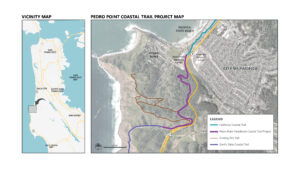
PACIFICA, CA, February 19, 2026. The California State Coastal Conservancy (Conservancy) has launched the next phase of project development for the Pedro Point Headlands Coastal Trail, a key step toward closing a longstanding gap in the California Coastal Trail–an envisioned 1,230-mile continuous, interconnected public trail system spanning Oregon to Mexico. Members of the public are invited to participate in the planning process taking place over the next two years.
The project will complete the design of an approximately 1.3-mile, multi-use trail connecting the City of Pacifica with the Devil’s Slide Trail and the Pedro Point Headlands open space. The design will aim to accommodate diverse users, such as hikers, cyclists, equestrians, and individuals with mobility limitations, while preserving the natural character of the headlands and providing a scenic, multi-modal alternative to Highway 1. Closing this gap will connect seven miles of uninterrupted coastal trail from Esplanade Beach to Devil’s Slide, improving public access to coastal resources and enhancing recreation and transportation connectivity across the region.
First envisioned more than three decades ago, the Pedro Point Headlands Coastal Trail has been identified as a priority in statewide and regional planning efforts. In 2020, the Conservancy funded a conceptual study with community engagement, which successfully identified a preferred alignment and conceptual design for Pedro Point Headlands Coastal Trail.
In early 2026, the Conservancy contracted BKF Engineers Inc., along with a multidisciplinary team of subconsultants, to embark on the next steps to plan the trail, which includes engineering, environmental review, permitting, and trail design, building on prior work. Planning is expected to continue through the end of 2027, positioning the project for construction in a future phase.
“The Pedro Point Headlands Coastal Trail represents a vital connection to the broader California Coastal Trail network,” said Erin Gravley, Conservancy Project Manager. “We are excited to move this next phase forward and help create a safer, more continuous coastal trail experience for local communities and visitors.”
The planning process will include community engagement, Tribal consultation, and coordination with local, regional, state and nonprofit partners to refine the preferred trail alignment and to ensure the project reflects shared community values of access and stewardship.
Community members interested in receiving project updates or learning about upcoming engagement opportunities are encouraged to sign up for the project mailing list. To learn more about the project, visit the project page here.
Grant Writing 101 Webinar, Dec 11
Join the California State Coastal Conservancy to learn helpful approaches to writing grant proposals. Our Project Managers will walk through strategies to develop a competitive application for Coastal Conservancy funding.
There will be time for Q&A.
A recording of this webinar will be posted on the Conservancy’s website afterwards.
SCC Grant Writing 101 Webinar
December 11, 2025 12-1pm
A recording can be found here.
Conservancy Board Awards over $15 million for Coastal Restoration, Public Access, and Wildfire Resilience
Nov 20, 2025 – OAKLAND, CA, Today, the Board of the State Coastal Conservancy awarded a total of over $15 million to projects that will help to restore the California coast, improve public access to it, and increase its resilience to climate change.
The majority of funding is going to ten projects that aim to reduce the risk and impact of catastrophic wildfires along the coast. Five of these are funded by the 2024 Climate Bond (Safe Drinking Water, Wildfire Prevention, Drought Preparedness, and Clean Air Bond Act of 2024 or Prop 4), which was overwhelmingly approved by voters in November of 2024. In April of 2025, Governor Newsom signed Assembly Bill 100 which allocated over $170 million in accelerated funding to conservancies for urgent forest and vegetation management across California.
The projects receiving a total of $9.4 million in 2024 Climate Bond funding from the Coastal Conservancy today are:
- Esselen Tribe of Monterey County: $1,250,000 to plan and implement a series of cultural fire trainings that include live fire cultural burning operations on 50 to 500 acres of land.
- La Jolla Band of Luiseño Indians: $2,900,000 to implement critical fuel reduction treatments and cultural burning on 516 acres along the Highway 76 corridor and to provide community fire preparedness training.
- Mendocino County Fire Safe Council: $803,000 to continue their free community chipping program, implement volunteer workdays, and develop a sustainability plan, over three years.
- University of California San Diego: $1,400,000 to remove Eucalyptus trees and restore the native chaparral ecosystem on a 30-acre site to improve wildfire resiliency and to serve as a biochar demonstration project.
- Sempervirens Fund: $3,050,000 to undertake the Big Basin Redwood Wildfire Resilience Project, consisting of vegetation fuels reduction and habitat enhancement on 215 acres in the old-growth coast redwood area of Big Basin Redwood State Park.
Five other wildfire resilience projects are being funded by the California Department of Conservation’s Regional Forest and Fire Capacity Program, totaling $1,665,000.
The other projects approved for funding are:
- A grant of up to $236,400 to The Hill Street Country Club to undertake the Hill Street Arts Hotel Feasibility Study, consisting of conducting community engagement and completing a feasibility study to establish a new lower-cost hotel in Oceanside, San Diego County.
- A grant of up to $450,000 to California State Polytechnic University, Humboldt to prepare the Murray Field Airport Sea Level Rise Planning and Economic Studyand to conduct community engagement to assess the impacts of and identify adaptation strategies for sea level rise at the Murray Field Airport in Eureka, Humboldt County.
- A grant of up to $181,400 to Friends of the Eel River to undertake theEel River Native Plant Network Project in anticipation of dam removal in the upper Eel River basin, consisting of: (1) launching a regional native plant network to assess, coordinate, and increase the regional capacity to produce native plants for Eel River watershed restoration projects beginning with Humboldt, Lake, and Mendocino Counties; (2) developing a feasibility report and a strategic plan; (3) hosting meetings and seed harvesting trainings; and (4) developing and launching a website.
- A grant of up to $445,000 to The Nature Conservancy to undertake the San Francisco Bay Olympia Oyster Public Education Initiative, consisting of targeted public education and outreach on the history and benefits of the native Olympia oyster to build public support for increasing the pace and scale of implementing nature-based approaches to shoreline protection while recovering Olympia oysters in San Francisco Bay.
- A grant of up to $71,400 to Sea Otter Savvy to educate the public on the historic role of sea otters and the potential future role of sea otter reintroduction within their historical habitat range in northern California and San Francisco Bay.
- A grant of up to $431,500 to Friends of the Dunes to acquire 6.52 acres of property adjacent to the Humboldt Coastal Nature Center at 150 Stamps Lane for public access, including potential low-cost overnight accommodations, and for habitat protection, restoration and enhancement; and to develop a habitat restoration and public access plan for the property in Manila, Humboldt County.
- A grant of up to $980,000 of grant funds from the U.S. Fish and Wildlife Service to the Land Trust of Santa Cruz County to acquire the 62 acre Watsonville Slough Mini Ranch property located within the Middle Watsonville Slough wetlands complex in Santa Cruz County to protect and restore natural resources and wildlife habitat, including wetlands; protect and enhance water quality; conserve sensitive species and wildlife corridors; and provide compatible agricultural use and California Native American .
- A grant of up to $565,000 to the Mendocino Land Trust to undertake the Arena Cove Coastal Trail Construction Project, consisting of construction of a 0.3-mile segment of the California Coastal Trail and related trail amenities at Arena Cove in Point Arena, Mendocino County.
- A grant of up to $800,750 to Sanctuary Forest, Inc.to: (1) acquire the 255-acre Ta’che—Nóó-nih Yaash Property to protect, restore, and enhance native species, habitats and waterways; protect cultural landscapes, features and attributes; and provide opportunities for compatible California Native American tribal access and potential limited public access in Whitethorn, Humboldt County; (2) remove cannabis infrastructure; (3) transfer the property to the InterTribal Sinkyone Wilderness Council; and (4) conduct initial stewardship planning for the property.
Regionally Advancing Living Shorelines in San Francisco Bay Project RFPs
11/19/25 RALS RFPs Updates
Please see Questions and Answers document on RFPs, with previous reports related to the RALS sites.
***
11/10/25 Updates
Regionally Advancing Living Shorelines
Regional Partner Requests for Proposals (SF, Marin East Bay)
Please note two updates:
- The deadline for proposals to the three RFP’s is extended to Thursday 12/4/25 5pm.
- Please see the teams meeting links below for the informational meetings-
Marin RFP Wed 11/12/25 1-2pm
East Bay RFP Fri 11/14/25 11am-12pm
San Francisco RFP Mon 11/17/25 1-2pm
Marin RFP Info Meeting- Wed 11/12 1-2pm teams call
Marin Audubon Society in coordination with State Coastal Conservancy
Microsoft Teams Need help?
Join the meeting now
Meeting ID: 287 586 985 086 9
Passcode: yV6mH3nJ
Dial in by phone
+1 949-943-1202,,91797719# United States, Irvine
Find a local number
Phone conference ID: 917 977 19#
East Bay RFP Info Meeting- Fri 11/14 11am-12pm teams call
Ducks Unlimited in coordination with State Coastal Conservancy
Microsoft Teams Need help?
Join the meeting now
Meeting ID: 265 489 863 187 02
Passcode: Cp7Jt9DU
Dial in by phone
+1 949-943-1202,,44762287# United States, Irvine
Find a local number
Phone conference ID: 447 622 87#
San Francisco RFP Info Meeting- Mon 11/17 1-2pm teams call
Golden Gate Bird Alliance in coordination with State Coastal Conservancy
Microsoft Teams Need help?
Join the meeting now
Meeting ID: 211 179 095 824 68
Passcode: q5Zb6DZ6
Dial in by phone
+1 949-943-1202,,259427335# United States, Irvine
Find a local number
Phone conference ID: 259 427 335#
****
10/31/25 Regionally Advancing Living Shorelines in San Francisco Bay Project
Release of Three Regional Partner Request for Proposals for Living Shorelines Design Services
Golden Gate Bird Alliance, Marin Audubon Society, and Ducks Unlimited in coordination with the California State Coastal Conservancy are seeking consultant services for the engineering and ecological design of living shoreline projects in three regions of Central San Francisco Bay as part of the Regionally Advancing Living Shorelines in San Francisco Bay (RALS) Project. The designs will integrate a variety of nature-based approaches and are part of the broader RALS effort to build the body of practice for advancing design and construction of living shorelines to increase climate resilience and shoreline protection in San Francisco Bay.
Please see the three separate Requests for Proposals here:
Please review the respective RFP’s (San Francisco, Marin, East Bay) for information on the design services and sites in each RFP, skills and experience required, dates for informational meetings, and who to contact for questions and submittals.
Proposals are due 12/1/25 by 3pm to Golden Gate Bird Alliance, Marin Audubon Society, and Ducks Unlimited, Inc. These are separate RFP’s being led by each entity and released at coordinated timing as part of the RALS project. Applicants may apply to one or more RFP’s.
San Francisco Bay Area Water Trail Implementation Meeting #45 – October 24, 2025, 10am – 11:30am
AGENDA
October 24, 2025
10:00 a.m. – 11:30 a.m.
VIRTUAL MEETING
Zoom link:
https://bayareametro.zoom.us/j/89030851416
Desired Outcomes of Meeting:
- Attendees are informed of Water Trail-related activities, progress, and accomplishments
- Attendees are updated on Water Trail interpretive and wayfinding signage effort
- After receiving Advisory Committee guidance, Project Management Team makes consensus-based decision on designation of Pacheco Marsh
Time/Agenda Item
10:00
- Welcome, Introductions, Agenda Review, and Meeting Ground Rules
10:15
- Updates and Announcements from Water Trail Staff, Project Management Team, and Advisory Committee Members, including update on Water Trail interpretive and wayfinding signage
10:50
-
- Presentation and Site Description review
-
- Discussion with Advisory Committee
-
- Advisory Committee consensus guidance to Project Management Team on trailhead designation
- Project Management Team discussion and decision on conditional designation
11:20
11:30
Agenda items may be taken out of sequence at the discretion of the Project Management Team; times are approximate.
Questions regarding this meeting may be addressed to Shalini Kannan, Coastal Conservancy Project Manager, at (510) 286-4167, or shalini.kannan@scc.ca.gov.
News Release: Coastal Conservancy Awards $8.7 million for Coastal Access, Restoration, and Wildfire Resilience
9/18/25 – Oakland, CA, Today, the Board of the State Coastal Conservancy awarded $8.7 million to a total of 11 projects to expand public access, enhance climate resilience, and mitigate coastal wildfire risk.
The projects include funding for the Conservancy’s Explore the Coast (ETC) program, which supports coastal programing for communities that face barriers to accessing or enjoying the coast . This year, the ETC program will fund 13 nonprofit organizations from Sonoma County south to San Diego County that will engage over 8,400 people through their projects. Of these people, project partners estimate that the program will serve over 6,700 low-income Californians, 7,000 people of color, 660 youth who are houseless or in foster care, approximately 3,200 people for whom English is not their first language, and at least 1,600 people with physical, cognitive, and/or emotional disabilities.
Other projects funded at today’s meeting include:
North Coast
A grant of up to $270,000 to the Westport Village Society to undertake the DeHaven Access Improvement Construction Project, consisting of construction of public access improvements, including a parking lot, a segment of the California Coastal Trail, signage, and stairway to DeHaven Beach in Mendocino County, and adoption of findings under the California Environmental Quality Act.
A grant of up to $240,200 to The Wildlands Conservancy to prepare plans for and implement the Estero Americano Public Access Infrastructure Improvements Project, consisting of installation of directional and interpretive signage, installation of 5 miles of trails, construction of a public restroom and kayak pull-in areas, and renovation of a dilapidated house to provide caretaker housing at the Estero Americano Coast Preserve in Bodega Bay, Sonoma County; and adoption of findings under the California Environmental Quality Act.
Authorization to amend the Conservancy’s grant authorized on February 15, 2024 to the Noyo Center for Marine Science for the Noyo Center Marine Field Station Resiliency Project (formerly the Marine Ecosystem Resiliency Project) to expand the scope of the project to include dock repair implementation at the Noyo Center’s Marine Field Station located at Noyo Harbor in Fort Bragg, Mendocino County.
A grant of up to $233,000 to the Noyo Center for Marine Science to augment the Conservancy grant authorized on September 5, 2024 to construct the Noyo Center Marine LaBONEatory Project (formerly the Noyo Center Ecosystem Resilience Initiative Project) and to modify the project to expand the 1,500 square foot multi-purpose work facility to 2,400 square feet to allow for greater coastal stewardship programming, marine science education, and community engagement, and to complete designs and permitting for the expanded facility.
Authorization to amend the Conservancy-required restrictions that limit use of the Napa Resource Conservation District’s 21-acre Huichica Creek Vineyard property to agricultural purposes so that the property can be used for habitat restoration and enhancement, natural resource protection, and potential public access. The property is located in the Huichica Creek Watershed in Napa County and was purchased for agricultural purposes with a Conservancy grant in 1991, when the property was known as Cabral Ranch.
A grant of up to $500,000 to the Mid Klamath Watershed Council to undertake the Upper Horse Creek Channel Restoration Project, consisting of the creation of side channels and off-channel ponds, the addition of wood structures, installation of beaver dam analogues, and the expansion of creek sinuosity to a segment of Horse Creek, in Siskiyou County.
San Francisco Bay Area
Authorization to amend the Conservancy’s previously authorized project award to the City of Berkeley to modify the project by cancelling the Cesar Chavez Park perimeter trail improvements, adding pier and parking lot improvements, and adding preparation of plans for improving a San Francisco Bay Trail segment at the City of Berkeley Waterfront, in Alameda County, and adoption of findings under the California Environmental Quality Act.
A grant of up to $3,091,148 to the City and County of San Francisco Recreation and Park Department, to augment the Conservancy grant authorized on February 15, 2024 of $5,500,000, to implement the India Basin Waterfront Park Phase 3: Shoreline Park Redevelopment Project, consisting of the redevelopment of the India Basin Shoreline Park in San Francisco into a mixed-use community park with improved public access and recreational amenities, enhanced habitat, and climate resilience.
A grant of up to $850,000 to the City of Albany to carry out the Albany–El Cerrito Wildfire Resilience Demonstration Project in Albany and El Cerrito (Alameda and Contra Costa Counties), consisting of: (1) implementing fire fuel vegetation management and ecological restoration; (2) investing in continuing partnerships for workforce development; and (3) demonstrating for public benefit useful practices for milling, native species planting, and fire hazard management; and adoption of findings under the California Environmental Quality Act.
A grant of up to $400,000 to the Santa Clara County Fire Safe Council to adapt their Community Wildfire Prevention Plan into a Regional Priority Plan, to establish a Prescribed Burn Association in Santa Clara County (South Bay Prescribed Burn Association) and, through the Prescribed Burn Association conduct initial workshops, classes, and training programs that will entail a series of small, prescribed burns on Midpeninsula Regional Open Space District lands with the goal of enhancing the ability of both private and public landowners to safely use prescribed burns to reduce wildfire severity and improve landscape health in Santa Clara County.
Central Coast
A grant of up to $80,000 to the Carmel River Steelhead Association to purchase equipment for use in annual rescues of steelhead in the Carmel River watershed in Monterey County.
A grant of up to $1,000,000 to the Coastside Land Trust to augment the Conservancy grant authorized on February 15, 2024 to construct priority components of Phase 2 of the Wavecrest Coastal Access Project at the Wavecrest property in Half Moon Bay, San Mateo County in order to expand the grant scope to include construction of the remaining Phase 2 components.
A grant of up to $1,068,300 to the City of Watsonville to prepare final designs and permit applications for the 0.5-mile second phase of the Lee Road Trail Project, which will add a 1.4-mile-long pedestrian and bicycle trail along Lee Road in Watsonville, Santa Cruz County; and adoption of findings under the California Environmental Quality Act.
Statewide
Funding of up to $966,316 to 13 nonprofit organizations for projects that facilitate and enhance the public’s opportunities to explore the California coast. Participants are drawn from throughout the State and will visit coastal locations from Sonoma County south to San Diego County.
Request for Quote for IT Services (RFQ-ITS)
The Coastal Conservancy has issued a Request for Quote for IT Services (RFQ-ITS), entitled State Coastal Conservancy Streaming, Video, & Audio Services Request for Quote, to provide Streaming, Video, & Audio Services for the State Coastal Conservancy meetings from September 1, 2025 – June 30, 2028. Quotes must be received no later than 5 pm on July 11, 2025
The California Coastal Conservancy is a state agency that supports projects to protect and enhance coastal resources and to expand public access to the coast. The Conservancy has a governing board comprised of 7 voting members and 6 oversight, non-voting members. The Conservancy Board holds public meetings up to six times a year in various locations around the state. Conservancy Board meetings are held in compliance with the Bagley Keene Open Meeting Act.
The period of performance for this contract is approximately three years with the option for the State to extend the term for up to two years.
The Conservancy holds its meetings in person but with an option for remote, video participation available to Board members, staff and members of the public.
This scope is to provide gavel-to-gavel audiovisual support for both in person and virtual meetings, live internet webstreaming (webcasting) services, and video documentation for archive of Conservancy meetings.
More information can be found in the RFQ here and on the Cal eProcure website here (Search for Event ID: 0000035876).
Questions Related to State Coastal Conservancy’s Request for Quotation For Information Technology Services (Cal eProcure Event ID: 0000035876) can be found here.
Answers to the RFQ-ITS questions can be found here. (Modified 7/10 1500PST)
Multi-Agency Coastal Flooding and Shoreline Resilience Funding Webinar, June 18
If you work along California’s coast and estuaries, join us for a webinar with state and federal agencies that work to address coastal flood risk and related shoreline resilience. There will be short presentations by agencies and time for Q&A.
Wed, Jun 18, 2025 10:00 AM – 11:30 AM
Register for the webinar here
We look forward to having you attend the event!
